Road to the Trophy: Football Tournament Game
Free interactive football puzzle game · Play in your browser
Rebuild a historic football tournament, order its standings and complete the route to the title. Play a new Road to the Trophy challenge every day.
Game guide
About Road to the Trophy
Rebuild one historic tournament's real route, from its standings to the later phases that decided the winner.
How to play
Everyone receives the same historical tournament for the day. Order the standings first, then progress through the recorded later phases and any knockout ties in that edition.
How a round works
- Read the tournament edition and the phase currently shown.
- Drag or select the teams into the order you think the historical table finished.
- Check the standings, review the official order, then continue to the next available phase.
- For knockout rounds, pick the teams that advanced through the recorded ties until the journey is complete.
What the game checks
The game uses a historical tournament edition with its teams, phase structure, table order and knockout path, so each answer is checked against that edition rather than a generic competition rule.
Methodology
Each daily journey is generated from one validated tournament edition. Its phase order, standings and recorded qualifiers are loaded as a connected package, which prevents a table from one season being combined with knockout results from another.
Limitations
Competition formats change over time, and some editions use second group stages, best runners-up or other tie-break rules. The interface follows the phases present in the selected record; it is not a universal explanation of every version of that competition.
Real game screen · Worked example
Worked example: reconstruct one historical edition, phase by phase
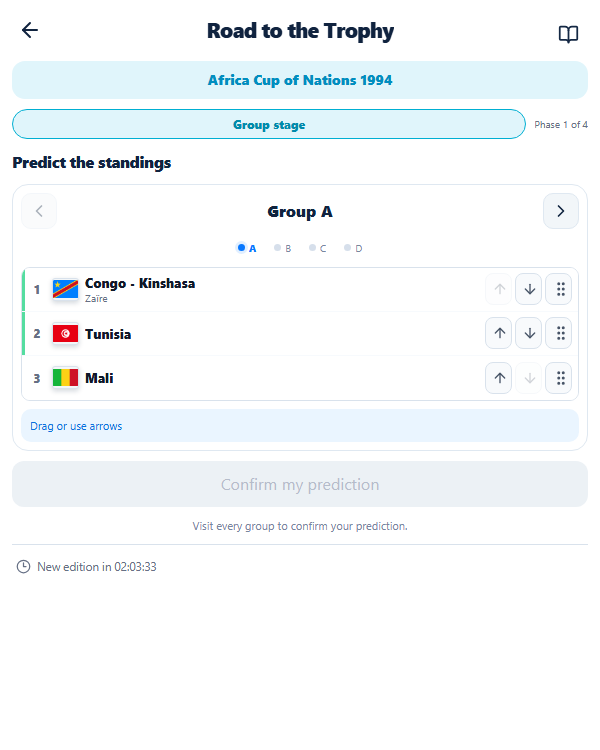
A team can top one group but still fail to win the tournament; use the later knockout phases instead of treating the opening table as the final result.
The screenshot names a specific edition: Africa Cup of Nations 1994. It shows Group A, navigation dots for three other groups and phase 1 of 4. That is the entire frame of reference. Remembering who usually wins this competition, or how a recent edition was formatted, will not reconstruct a historical table from 1994.
1. Freeze the edition before moving a team
Read both the competition and the year aloud. Formats, participants and tie-break rules can change between editions. The board's team list is part of the evidence; do not mentally replace it with the field of a later tournament. The arrows beside Group A move to the other groups, which are separate tables: a team in Group A cannot be ordered relative to a team in Group B at this stage.
2. Form a group-stage hypothesis
Within each group, use what you know about the historical results to place first, second and later finishers. Drag a row or use its up/down arrows. The controls update 'Your order'; they do not reveal the official table as you move. If you are unsure about two adjacent teams, put the stronger evidence first and remember which swap you may need after checking.
3. Visit every group, then check the order
Use the side arrows or group dots to inspect every table. The confirm button remains unavailable until each group has been visited; that prevents you from sending a half-read board. Submit when every group reflects your best reconstruction. The game compares your order with the recorded edition and shows the official order before you continue. Look at a wrong pair as a historical fact to investigate, not a reason to assume every later phase is also wrong.
4. Move forward through only the phases shown
Use the next-round control. Some tournaments have a straightforward knockout bracket; other historical editions include different group or qualifying structures. Footalara follows the phases stored for the selected edition. In a knockout tie, choose who advanced in that actual tie rather than who seems more likely to win today.
5. Separate 'group winner' from 'champion'
The team that tops an early group does not automatically lift the trophy. A later opponent, extra time or a penalty shootout may change the path. Keep a simple chain of qualifiers from one screen to the next. When the journey ends, you will have reconstructed the route, not just named a champion.
Common mistakes
- Using a modern tournament format for a historical edition.
- Mixing teams from different groups while ordering the first phase.
- Treating the group standings as the final tournament ranking.
What to remember: Anchor every decision to the edition on screen, then advance one recorded phase at a time. The route matters as much as the winner.
Corrections
Report the tournament edition, phase and disputed team order or qualifier. Footalara can review that edition's source package and correct the relevant phase without rewriting the historical format.
Tips
- Separate group-stage consistency from knockout survival when you reconstruct a tournament.
- Check the edition and season before relying on a modern format you remember from a different era.
Questions
Is the same tournament shown to everyone?
Yes. Road to the Trophy uses the same historic tournament for every player on that day.
What do I do after checking a table?
Review the official order, then use the next-round control to continue through the tournament path.
How are knockout rounds played?
For a knockout phase, choose the teams that advanced through the historical ties recorded for that edition.