Football Trivia for Beginners: Six Questions That Teach the Basics
Test six common football distinctions: players, match time, formations, offside, starting status and a penalty shoot-out result.
Introduction
Start with questions whose answers help you follow a match. Try these six before reading each explanation. Look for the word or situation that changes each answer before trying to memorise a long rulebook. The rules referenced below concern association football, with competition-specific variations identified where relevant.
1. Does eleven players include the goalkeeper?
Yes
Under IFAB Law 3, each side has up to eleven players, including one goalkeeper. Do not add a goalkeeper to eleven outfield players. In a lineup puzzle, counting the names is a useful first check before examining whether every player started.
Sources: IFAB — Law 3: The Players
2. Is a standard match exactly ninety minutes on the clock?
It has two 45-minute halves, with time allowances
Law 7 sets out two equal halves of 45 minutes, subject to the permitted arrangements in the law and competition rules. The referee allows for time lost. Added time belongs to the relevant half; extra time is a separate way some competitions resolve a tie. Do not use the two terms interchangeably.
3. Does 4-3-3 include the goalkeeper in its numbers?
Normally, no
The conventional label describes ten outfield players: four defenders, three midfielders and three forwards. The goalkeeper is understood separately. The label describes a tactical arrangement; no law requires players to remain in those lines. A winger tracking back can change the picture without changing the names in the starting eleven.
4. Is standing in an offside position always an offence?
No
Law 11 distinguishes position from an offence. The decision considers a player's involvement after a teammate plays or touches the ball. As a beginner's example, compare a player who receives the pass from an offside position with one who remains uninvolved elsewhere. Interfering with an opponent can also matter, so not touching the ball is not an automatic exemption.
Freeze the image at the relevant teammate's touch before following what the attacker does. Being ahead of the ball alone does not establish the whole decision: the opponent's half, the second-last opponent and the law's exceptions also matter. Use the linked law for the complete criteria.
Sources: IFAB — Law 11: Offside
5. Did every player who scored start the match?
No: a substitute can score
Patrick Kluivert scored Ajax's winner against Milan in the 1995 Champions League final after coming on as a substitute. If the question asks for the scorer, he is the answer. If it asks for a member of Ajax's starting XI, that goal does not establish that he belongs in the answer.
6. Is a shoot-out score added to the match score?
Keep them separate
Law 10 treats the penalty shoot-out as occurring after the match has ended. Liverpool and Milan finished the 2005 final at 3–3, with Liverpool winning the shoot-out 3–2. Describe both results separately. Adding the kicks to produce a 6–5 match score loses the distinction between goals during the match and the procedure used to decide the winner.
Sources: IFAB — Law 10: Determining the Outcome of a Match · UEFA — Liverpool triumph in Turkey, 25 May 2005
Turn a wrong answer into a better question
Change one detail and try again
If you missed question one, ask how many outfield players make a full eleven. If you missed question five, ask separately for a starter and for the winning scorer in the same match. If you missed question six, write one line for the result after extra time and another for the shoot-out.
When playing with a friend, accept an explanation in ordinary language before insisting on specialist vocabulary. You can increase the difficulty later by adding dates, opponents or exact actions. Keep the question precise enough that a source can settle a disagreement.
Quick comparison
| Concept | Useful for | Watch for |
|---|---|---|
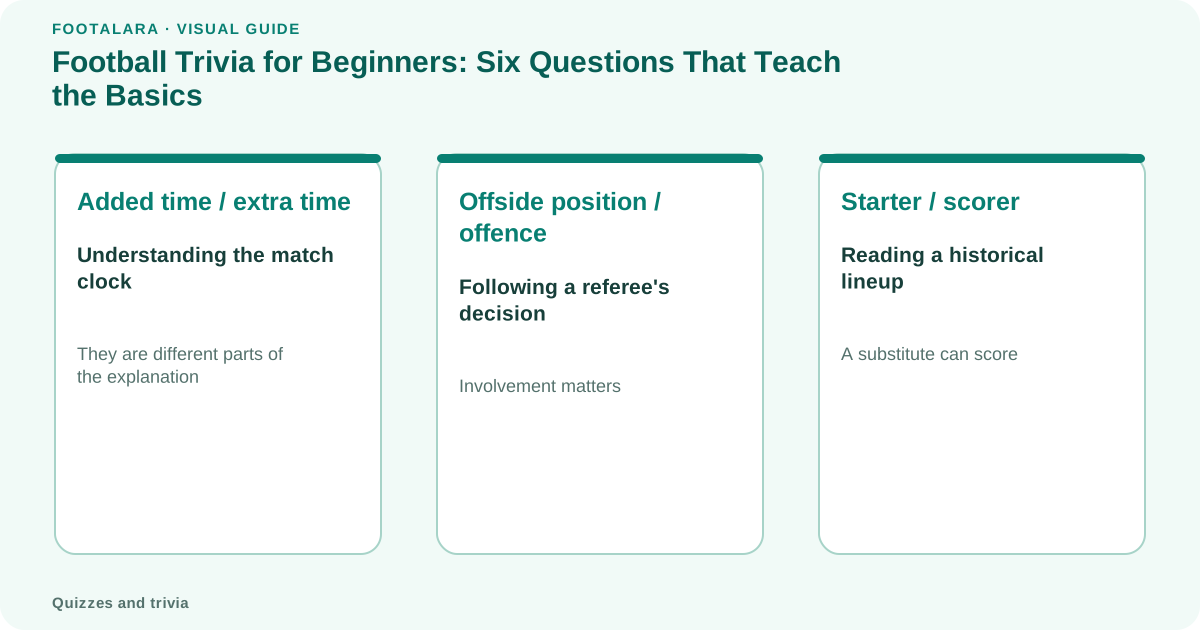
| Added time / extra time | Understanding the match clock | They are different parts of the explanation |
| Offside position / offence | Following a referee's decision | Involvement matters |
| Starter / scorer | Reading a historical lineup | A substitute can score |
| Match / shoot-out | Reporting a knockout result | Record two scores separately |
Explain the 2005 final result accurately
- Write Milan 3–3 Liverpool as the match result.
- Add that Liverpool won the shoot-out 3–2.
- Name Liverpool as the competition winner.
- Explain why the shoot-out kicks are not added to the 3–3 score.
Practical checklist
- Read the limiting word
- Separate the two concepts
- Explain the answer aloud
- Check a rule or match record
Frequently asked questions
Must I know every exception before playing a quiz?
No. Start with clearly worded questions and consult the full law when an exception affects the answer. A short quiz explanation should not be mistaken for the complete rule.
Conclusion
The most useful beginner facts prevent two nearby ideas from being confused. Once you can explain these six distinctions, use them while watching a match or tackling your next quiz.