Hard Football Quiz Questions: Six Answers with the Decisive Clue
Try six precise questions about European finals, substitutions and competition formats, then check the reasoning and original sources.
Introduction
A difficult question should make you distinguish two plausible answers, not guess what the writer meant. These six questions have fixed dates and a checkable answer. Cover each answer paragraph while attempting the question. Give yourself one point for the name or season and one for the detail that separates it from the tempting alternative.
1. Who scored four for Real Madrid in the 1960 European Cup final?
Answer: Ferenc Puskás
Madrid beat Eintracht Frankfurt 7–3. Puskás scored four and Alfredo Di Stéfano scored three. The trap is remembering that Di Stéfano scored a hat-trick and giving his name before checking the number in the question. Write the two names beside four and three so you remember the distinction.
2. Which 1995 final match-winner began on the bench for Ajax?
Answer: Patrick Kluivert
Kluivert entered as a substitute and scored the only goal against Milan in Vienna. A question about the scorer has his name as the answer; a question asking you to fill Ajax's starting eleven does not. This is a test of starting status as well as a famous goal.
3. Who scored Marseille's winner in the 1993 final?
Answer: Basile Boli
Boli's goal gave Marseille a 1–0 win over Milan. Kluivert is a tempting nearby memory because he also decided a final against Milan in the same decade. The club and year distinguish the events. If you missed this, review the two questions as a pair instead of as unrelated facts.
4. Which Liverpool starter did Šmicer replace in Istanbul?
Answer: Harry Kewell
Kewell left injured after 23 minutes of the 2005 final. Šmicer later scored during Liverpool's recovery from 3–0 down. The question asks for the player who went off, so knowing the substitute's goal is only the first half of the answer. The substitution is recorded in UEFA's report and match sheet.
Sources: UEFA — Liverpool triumph in Turkey, 25 May 2005 · UEFA — Milan v Liverpool, official 2005 final line-up sheet
5. Who supplied the touch before Solskjær's winner in the 1999 final?
Answer: Teddy Sheringham
From David Beckham's corner, Sheringham headed the ball on and Ole Gunnar Solskjær finished. Beckham took the corner but was not the player providing the intervening touch. Read whether a question asks about the corner taker, the last teammate to touch the ball, or the scorer: those are three different answers.
6. Which season replaced the second group phase with a knockout round of 16?
Answer: 2003/04
UEFA introduced two group stages in 1999/2000 and replaced the second with the round of 16 in 2003/04. The change is different from the 1992/93 Champions League identity and the 2024/25 league phase. Attach each season to its own structural change rather than storing them under a vague 'new format' label.
Sources: UEFA — Setting the standard for club football: competition timeline
Read your result by error type
Twelve available points, six useful distinctions
A missed name means you need another encounter with the event. A correct name with the wrong reason means your clue is fragile. An answer to a different question means you should underline the limiting words next time: four, starter, replaced, last touch, or season.
To make a second round, change only one fact in a question and write a fresh answer key. Ask for the three-goal scorer in 1960 or the corner taker in 1999. Check that your revised question still has a single answer before giving it to someone else.
Quick comparison
| Concept | Useful for | Watch for |
|---|---|---|
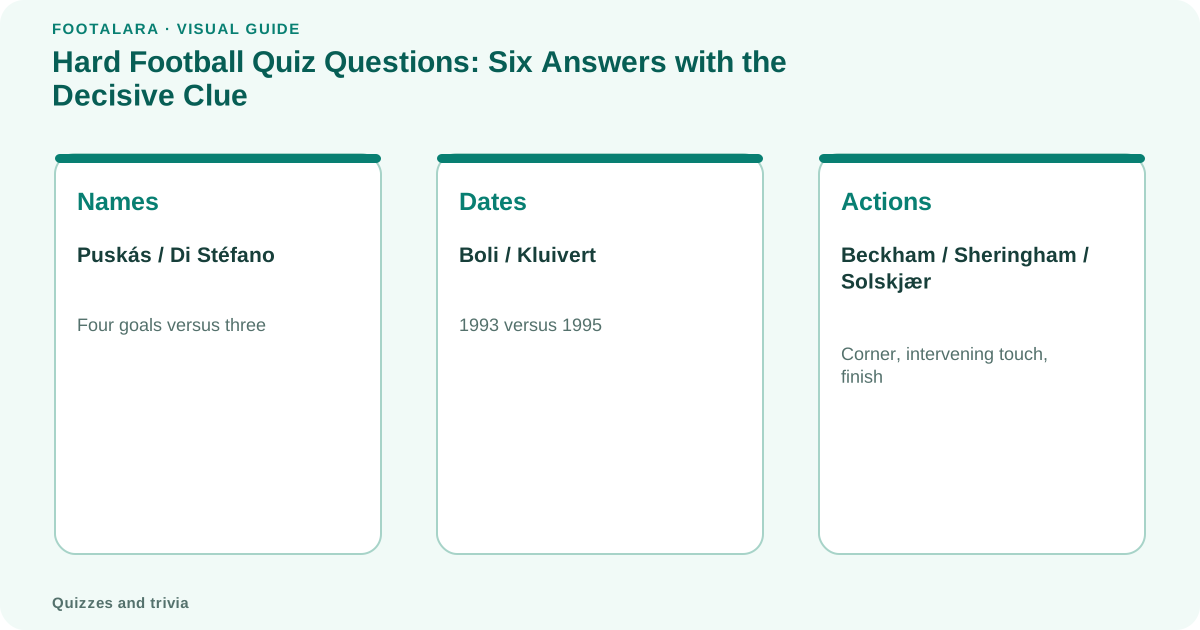
| Names | Puskás / Di Stéfano | Four goals versus three |
| Dates | Boli / Kluivert | 1993 versus 1995 |
| Actions | Beckham / Sheringham / Solskjær | Corner, intervening touch, finish |
Make question five harder without making it vague
- Start with the exact 1999 final and winning goal.
- Ask separately for the corner taker and the player who headed the ball on.
- Answer Beckham and Sheringham, in that order.
- Keep the two actions in the question so both answers can be checked.
Practical checklist
- Attempt before revealing
- Underline the limiting detail
- Give a reason as well as a name
- Use the linked record to check
Frequently asked questions
Are these objectively the hardest football questions?
No. Difficulty depends on your football background. They are selected for precise distinctions that familiar highlights can hide.
Conclusion
A hard question becomes useful when you can explain the clue that made its answer unique. Keep that distinction when you review the questions you missed.
Sources
- UEFA — 1959/60: Dazzling Madrid crush Frankfurt
- UEFA — 1994/95: Kluivert strikes late for Ajax
- UEFA — 1992/93: French first for Marseille
- UEFA — Liverpool triumph in Turkey, 25 May 2005
- UEFA — Milan v Liverpool, official 2005 final line-up sheet
- UEFA — Solskjær recalls the 1999 final
- UEFA — Setting the standard for club football: competition timeline