Champions League History: A Timeline of Format Changes
Connect 1955/56, 1991/92, 1992/93, 1999/2000, 2003/04 and 2024/25 to the competition formats that make historical questions easier to answer.
Introduction
A trophy list tells you who won. A format timeline also tells you what they had to win. The European Cup and the Champions League belong to the same competition's history, but entry rules and routes to the final have changed. Use season labels, not only calendar years, to keep those changes attached to the right tournament.
1955/56: the competition begins
Start with a final you can place
The inaugural European Champion Clubs' Cup was a 16-team invitational competition. Real Madrid defeated Reims 4–3 in its 1956 final. By 1967/68, the tournament proper used a 32-team knockout structure with four two-legged rounds before the final.
Write the season on one side of a memory card and the format plus one match on the other. This prevents a common shortcut: assuming the earliest editions used every access rule that became familiar later.
Sources: UEFA — Setting the standard for club football: competition timeline
1991/92 and 1992/93: two separate milestones
Group football precedes the new name
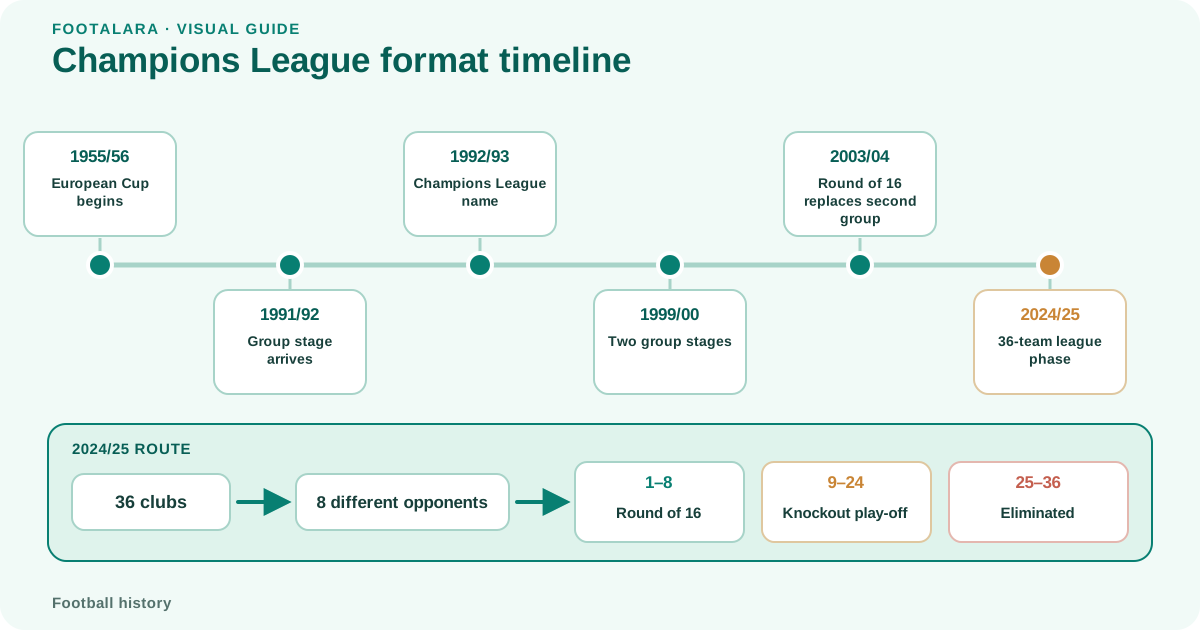
A group stage appeared in 1991/92: eight surviving clubs entered two groups, whose winners reached the final. The Champions League identity followed in 1992/93. Marseille won that edition, beating Milan 1–0 through Basile Boli.
When a question asks for the first Champions League winner, Marseille is the relevant answer. When it asks for the first European Cup winner, the answer belongs to 1955/56. Read which boundary the question chooses before reaching for the most familiar club.
Sources: UEFA — Setting the standard for club football: competition timeline · UEFA — 1992/93: French first for Marseille
1997/98 to 2003/04: expansion, then a shorter route
The second group stage is a real historical distinction
In 1997/98, runners-up from the top eight associations could enter and the group stage expanded to 24 clubs. In 1999/2000, 32 teams entered a first group stage followed by a second group stage. In 2003/04, a knockout round of 16 replaced that second group phase.
For a route-to-the-trophy puzzle, this is more useful than treating every opponent as a knockout victim. Before ordering matches, mark each as group, knockout first leg, knockout second leg or final. A club can face the same opponent in different contexts; the opponent's name alone does not identify the round.
Sources: UEFA — Setting the standard for club football: competition timeline
2024/25: the league phase
One table does not mean everyone plays everyone
The format introduced in 2024/25 places 36 clubs in one league-phase table. Each plays eight different opponents, with four matches at home and four away. The top eight advance to the round of 16; positions nine to 24 enter a knockout play-off. The remaining clubs are eliminated.
Keep 'eight opponents' distinct from the old pattern of playing three group opponents twice. A single table can compare teams with different schedules. Each club meets eight opponents instead of all 35 other clubs.
Sources: UEFA — Champions League format introduced in 2024/25
Use a three-question history check
Name, format and season
First identify what the competition was called in the question. Then identify the stage structure in that season. Finally verify one anchor match in an official record. This gives you a way to resolve ambiguity rather than collecting disconnected dates.
Try it with 2002/03 and 2003/04: which contains a second group phase, and which contains a knockout round of 16? The dates look close, but the route changes. Your answer should include the structural difference as well as the season.
Work Porto's 2003/04 route stage by stage
Group results and two-leg totals answer different questions
Porto's route is a compact example of the 2003/04 structure. In Group F they drew 1–1 away to Partizan, lost 3–1 at home to Real Madrid, beat Marseille 3–2 away and 1–0 at home, beat Partizan 2–1 at home, and drew 1–1 away to Madrid. Those six results formed a league table and sent Porto into the first knockout round; the group paired no two matches as one tie.
The accounting changes after the group. Porto beat Manchester United 2–1 at home and drew 1–1 away, advancing 3–2 across two legs. They beat Lyon 2–0 at home and drew 2–2 away, advancing 4–2. After a 0–0 home draw with Deportivo, Porto won 1–0 away for a 1–0 two-leg total. The final was a single match: Porto 3–0 Monaco.
Write the route as six group results, then three two-leg totals, then one final score. That layout prevents a factual category error such as calling the Marseille games a knockout tie or adding the Monaco final to another leg.
- Group F: six table-building matches.
- Knockout totals: Manchester United 3–2, Lyon 4–2, Deportivo 1–0.
- Final: Porto 3–0 Monaco in one match.
Sources: UEFA — Porto prove confident campaigners: official 2003/04 road to the final · UEFA — Monaco 0–3 Porto, official 2004 final report
Use the route to compare structures, not difficulty
The round label tells you how a result advanced the winner
The same score has a different structural meaning at each stage. Porto's 1–1 at Real Madrid contributed one point to a six-match group record. Their 1–1 at Manchester United completed a 3–2 two-leg win because it followed a 2–1 first leg. The 0–0 with Deportivo settled nothing on its own, but it left the return match in Spain to settle the semi-final. The 3–0 against Monaco required no return match.
This worked route shows the 2003/04 sequence in practice: one group followed by a round of 16 and further home-and-away eliminations. When reconstructing another season, build its template from the official stage labels instead of assuming Porto's sequence applies unchanged. The route is useful precisely because each result remains attached to the stage that gave it meaning.
For a cross-era comparison, draw each champion's stages in parallel columns. Record the number of group opponents, two-leg rounds and single-match rounds before comparing the routes. This makes a changed structure visible and keeps a judgement about difficulty separate from the match record.
- Point: contributes to a group table.
- Two-leg total: combines both matches in one tie.
- Final score: settles a single-match final.
Sources: UEFA — Porto prove confident campaigners: official 2003/04 road to the final · UEFA — Monaco 0–3 Porto, official 2004 final report
Quick comparison
| Concept | Useful for | Watch for |
|---|---|---|
| 1955/56 | Beginning of the European Cup | An invitational first edition |
| 1991/92 → 1992/93 | Group stage, then Champions League identity | Two milestones, not one |
| 1999/2000 → 2003/04 | Two group stages, then a round of 16 | Different routes to the final |
| 2024/25 | 36-team league phase | Eight opponents per club |
Repair an ambiguous quiz question
- Read 'Who won the first Champions League?'
- Check whether the author means the rebranded 1992/93 edition or the original European Cup.
- Use Marseille for 1992/93 and Real Madrid for 1955/56.
- Rewrite the question with the season so it has one answer.
Practical checklist
- Use season labels
- Separate first group stage from rebranding
- Identify the relevant round structure
- Verify one anchor match
Test your understanding
Try each question before opening the answer. Use the explanation to check your reasoning.
How should a reader divide Porto's 2003/04 route by competition structure?
Show answer and explanation
Six group matches, three two-leg knockout ties, then one single-match final.
The group results build a table; Porto won the Manchester United, Lyon and Deportivo rounds across two legs; Monaco is the final itself.
Why did Porto's 1–1 at Manchester United advance them, while their 1–1 at Real Madrid did not decide a tie?
Show answer and explanation
The United draw completed a knockout tie that Porto won 3–2 across two legs; the Madrid draw was one result in Group F.
The stage determines how the competition uses the same score.
Frequently asked questions
Did the European Cup disappear from the historical record?
No. UEFA presents both eras in the competition's history. A statistic must make clear whether it covers the full history or only the Champions League era.
Conclusion
Learn the points where the route changed. They explain why a winner from one era faced a different task and help you read historical questions precisely.