Guess the Player II: Football Similarity Game
Free interactive football puzzle game · Play in your browser
Find the hidden footballer using similarity scores for clubs, nationality and teammates. Refine each guess in Footalara's daily player similarity game.
Game guide
About Guess the Player II
Use football similarity percentages to locate the hidden player: a higher score means stronger real-world connections.
How to play
Each percentage is an absolute football estimate, led by shared clubs and nationality rather than by a player's place in the full catalogue.
How a round works
- Search for any player in the available catalogue and submit a first guess.
- Read the percentage: higher values are closer, while 100% is the hidden answer.
- Start with shared clubs and nationality, then use teammate years, age, position and fame to separate close candidates.
- Keep refining the same football context instead of treating every attempt as an unrelated trivia guess.
What the game checks
The score is not a catalogue percentile. Unrelated famous players stay low, and the 99% band is limited to ten exceptional connections.
Methodology
Similarity is calculated from comparable career evidence, led by shared clubs and nationality and refined by teammate overlap, age, position and a limited fame signal. The same calibrated calculation is used for every eligible guess in the daily puzzle.
Limitations
A percentage describes the model's evidence, not an objective verdict that two careers are identical. Missing career stages, sparse historical coverage or different positional labels can weaken a connection, especially for players from less completely documented eras.
Real game screen · Worked example
Worked example: follow the percentage, then test the connection
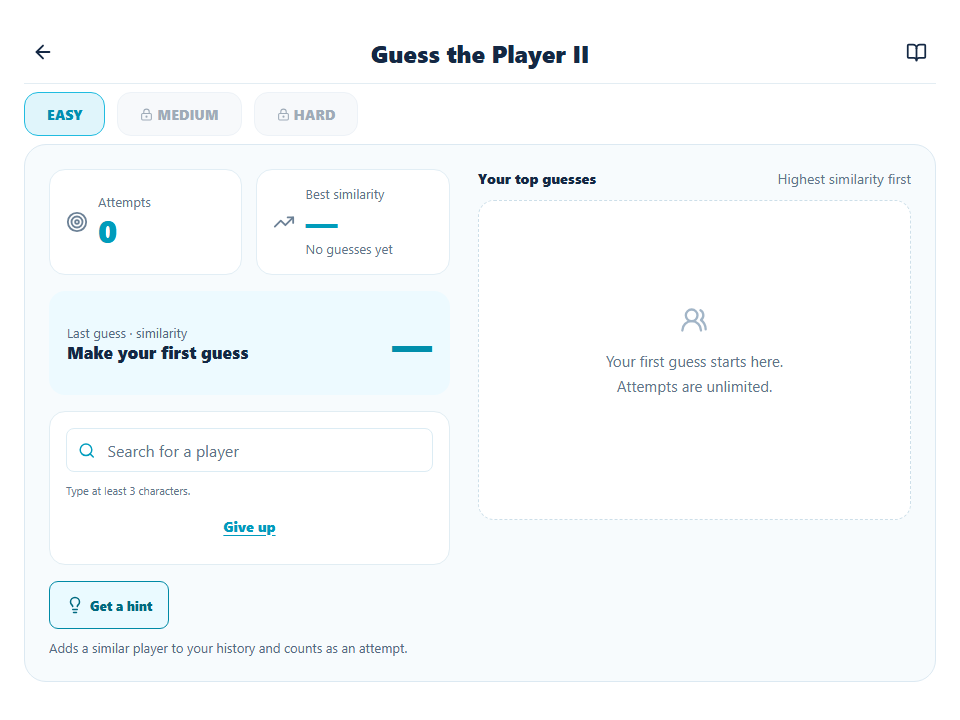
If one guess is much closer than another, follow the close player's career route or national-team context before changing position at random.
This game is closer to navigating a map of football careers than answering a single trivia question. The screenshot starts at zero guesses. In the hypothetical sequence below, the percentages only illustrate how to react to feedback; they are not scores assigned to real players or clues to a live daily answer.
1. Establish a reference point
Search for a footballer whose career you know well. Suppose the first result is 18%. That is useful: this player's clubs, national-team context, age and role do not strongly overlap with the hidden record. Do not read 18% as an 18% chance of being right. It is a similarity signal from the game's career model.
2. Change one football dimension
Instead of jumping to a random star, choose a player linked to a different club or nationality cluster. Imagine the next result rises to 74%. Now you have a promising region of the career map. Ask which feature could explain the rise: a shared senior club, a national team, overlapping teammate years or a similar age/position profile. Fame alone is a weak explanation.
3. Test a neighbour of the strong guess
Try a teammate or a player who followed a similar club route. Suppose the next result is 92%. Compare the two high guesses: which clubs or national-team stages do they share that the 18% player did not? This is more efficient than alternating between unrelated leagues. The top-guesses panel keeps high scores visible so you can build a coherent chain.
4. Use the hint as another attempt
Get a hint adds a similar player to your history and counts as an attempt. It can establish a helpful direction when your own shortlist stalls, but the hint does not hand you the hidden identity. Unlimited attempts mean you can keep testing a hypothesis; they do not make each percentage an official ranking of footballing ability.
5. Know what finishes the puzzle
A 100% result is the hidden footballer. Scores just below that mark can still represent multiple close career connections, so avoid assuming a 99% guess proves the answer is the next teammate you remember. Re-check the whole route and submit the player whose identity matches it.
Common mistakes
- Treating similarity as a win probability or a universal player ranking.
- Changing several variables between guesses so the new score explains nothing.
- Forgetting that a hint becomes part of the attempt history.
What to remember: A low, medium and high sequence becomes valuable only when you can name the career feature that changed between guesses.
Corrections
Report implausible pairings with both player names and the displayed percentage. Footalara can inspect the contributing career fields and correct a source record or calibration issue without altering the hidden answer arbitrarily.
Tips
- A score in the 99% band signals an exceptional career connection, not merely a famous player.
- Use age and position after you have found a plausible club or nationality cluster.
Questions
What does 100% mean?
100% is the hidden footballer and completes the daily puzzle.
Are higher percentages better?
Yes. A higher percentage means stronger football evidence connecting the guess to the hidden answer.
What should I use after a close guess?
Start with shared clubs and nationality, then use teammate years, age, position and fame to separate close candidates.