Football Positions Explained: Names, Roles and What to Watch
Learn the difference between a position and a task, then follow a goalkeeper, full-back, midfielder and forward through one passage of play.
Introduction
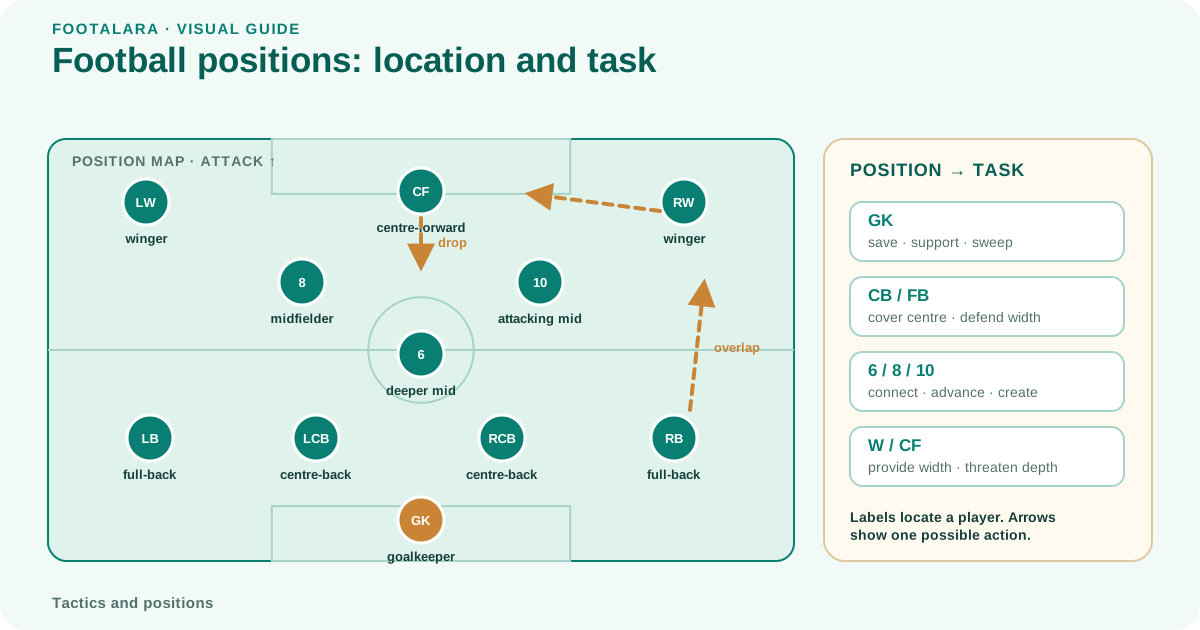
A position tells you where to start looking for a player. A role tells you what that player is asked to do. A left-back can move into midfield during possession; a centre-forward can drop towards the ball. Learn the names as a map, then watch the actions that make each player useful.
Goalkeeper: the view behind the team
Saving, supporting and protecting space
IFAB's Law 3 requires one player to be the goalkeeper. The outfield positions are tactical choices rather than compulsory categories in the law. FIFA's goalkeeper session examines positioning both when the team has the ball and when it does not: the goalkeeper's work continues between shots.
During build-up, watch whether the goalkeeper offers a return pass at a useful angle. When possession moves forward, look at the distance to the defenders. Standing farther from the goal may help cover a pass behind a high defensive line, but the decision depends on pressure on the ball and the space that must be protected.
Sources: IFAB — Law 3: The Players · FIFA Training Centre — Goalkeeper positioning in and out of possession
Centre-back, full-back and wing-back
Central cover and the wide corridor
Centre-backs usually protect central areas and help start attacks. Full-backs begin on the sides of a back four. Wing-backs commonly provide width outside three centre-backs and can recover into a defensive line of five. These descriptions help locate players; they do not prescribe a fixed height on the pitch.
Follow a wide defender for one attack. An overlap takes him outside a teammate; an underlap takes him inside. An inverted full-back moves into a central area, as illustrated by FIFA's Chelsea analysis. Ask who supplies width after that movement and who can defend the original channel if the ball is lost.
Sources: FIFA Training Centre — Chelsea: The inverted full-back and central overloads, 2025
Six, eight and ten
Role shorthand, not guaranteed shirt numbers
A six usually refers to a deeper midfielder connecting play and protecting the centre. An eight often works between the deeper and attacking areas. A ten commonly operates behind the forwards, looking to receive between opposing lines. A team may split these tasks differently, so the labels should begin your observation rather than end it.
In an illustrative possession, the six offers a pass behind the opponent's first pressing line, an eight moves diagonally to receive the next ball, and a ten finds space closer to the opposing defence. If all three stand on the same line behind one marker, the names on the team sheet do not create three usable passes.
Winger and centre-forward
Width, depth and movement towards the ball
A winger can stretch the pitch near a touchline or move inside while a teammate provides width. A centre-forward can threaten behind defenders, hold a central position or come short to connect a pass. A false nine describes a central forward dropping into deeper areas; it does not mean that the team has no attacking responsibilities in the centre.
Watch the response to one movement. When the forward comes short, does a winger or midfielder run into the space behind? If nobody does, the team might gain a passing option without threatening the defensive line. A useful explanation connects at least two players instead of describing one player's movement in isolation.
Write actions beside the abbreviations
A short viewing exercise
Pause a match at a goal kick and label the players you can identify: GK, CB, FB, midfielder and forward are enough. Follow the next three passes. Under each involved player, write a verb such as supports, receives, carries, overlaps or covers.
Now compare the labels with the actions. A full-back receiving centrally is still recognisable from where he began. A midfielder joining the forwards may still have a recovery task behind them. This exercise helps you read a lineup without assuming that a formation graphic describes every moment.
Read a role as an information-action loop
Look before, during and after the touch
A position label tells you where to find a player; a role becomes visible in repeated decisions. Start one second before the player receives. What information can they collect about pressure, teammates and space? FIFA's presentation on scanning describes scans as brief searches mainly for colour, movement and space, and links perception to the action that follows. Counting head turns alone gives an incomplete answer. The useful question is whether the information changes the player's next movement or touch.
Use a central midfielder as a worked observation. Before a square pass arrives, she checks over the far shoulder and sees an opponent closing from behind. She opens her body, cushions the ball back to the centre-back and immediately moves to a new angle. The backward pass is not evidence that she failed to progress play; it may preserve possession and move the marker so a later forward lane opens. Record three verbs: scans, returns, repositions. Together they describe the role in that moment more precisely than 'number eight' by itself.
- Before: what pressure or space could the player see?
- During: did the touch protect, progress, combine, or finish?
- After: did the player support again, run beyond, or provide cover?
Use the same restart to compare different jobs
One goal kick reveals more than a lineup abbreviation
This original sequence is illustrative, not analysis of an actual match. The goalkeeper passes to a centre-back, then moves sideways to remain available. The full-back takes up a high receiving position, the holding midfielder shows between two pressers, and the centre-forward checks short while a winger threatens the space behind. FIFA's goal-kick framework separates distribution into playing around and supporting, through, into, onto, or beyond the opposition. Those categories help describe the relationships created by different positions in one phase.
Pause after the first pass. The goalkeeper supports the player on the ball; the centre-back decides whether to carry, return or find a higher line; the midfielder offers the route for playing through; the high full-back is the receiver for playing into; the centre-forward is the target for playing onto; and the winger threatens the area for playing beyond the defence. FIFA uses those examples to classify the goalkeeper's distribution. The rest of this sequence applies the framework as an observation exercise, and the next opponent movement may change each player's assignment.
Judge a role by what its movement enables and removes
Every useful relocation carries a tradeoff
Consider a holding midfielder dropping between the centre-backs. The movement can create an extra first-line passer and give the outside centre-backs room to separate. It can also remove a receiver from midfield, so a teammate may need to occupy that central connection. FIFA's position-specific training material describes the number six as a link in build-up, a protector of central space and a player capable of dropping into the defensive line. Those responsibilities can pull in different directions within the same attack.
Build your verdict with two clauses: 'The player moved here to enable ___; this left ___ for a teammate to solve.' Apply it to a full-back moving inside, an eight running beyond, or a centre-forward dropping short. Then watch the next two actions to test the claim. If nobody fills the vacated space, the move may still be intentional but poorly connected. If a teammate reacts and the team creates a new passing route while preserving cover, you have evidence of a coordinated role rather than movement judged in isolation.
Sources: FIFA Training Centre — Developing players using position-specific training
Quick comparison
| Concept | Useful for | Watch for |
|---|---|---|
| Full-back / wing-back | Locating the wide defender | Starting structure and recovery line differ |
| Six / eight / ten | Describing midfield responsibilities | A shirt number alone proves no role |
| Winger / centre-forward | Finding width and central depth | Movement may exchange those jobs |
Describe an overlap without tactical jargon
- Find the winger with the ball near the touchline.
- Follow the wide defender running past on the outside.
- Check whether the winger passes, dribbles inward or keeps the ball.
- Look behind the move to identify the player covering that side.
Practical checklist
- Locate the starting position
- Identify the phase
- Describe one action
- Find the teammate affected
Test your understanding
Try each question before opening the answer. Use the explanation to check your reasoning.
A midfielder scans, receives, and immediately returns the ball backwards. What evidence would make that a useful role action rather than a failed attempt to progress?
Show answer and explanation
The return avoids pressure and the midfielder repositions to help open or receive through a new lane.
Direction alone does not judge the action. Connect the information gathered before receiving to the next team option the player helps create.
A number six drops between the centre-backs during build-up. What space should you inspect next?
Show answer and explanation
Inspect the central midfield space the six has left and identify which teammate can provide the next connection there.
Dropping may improve the first passing line, but its value depends on how the team replaces the higher central option and protects the centre.
Frequently asked questions
Can one player have more than one position?
Yes. A player can be selected in different positions across matches and can perform different tasks within a single match. Use the particular lineup and phase as your reference.
Conclusion
Use position names to find the player and action words to explain the play. The connection between a move, its support and the space left behind is more informative than the label alone.
Sources
- IFAB — Law 3: The Players
- FIFA Training Centre — Goalkeeper positioning in and out of possession
- FIFA Training Centre — Chelsea: The inverted full-back and central overloads, 2025
- FIFA Training Centre — Karl Aksum on scanning
- FIFA Training Centre — Building from goal kicks
- FIFA Training Centre — Developing players using position-specific training