Football Formations Explained: Read the Shape and the Phase
Learn what 4-3-3, 4-2-3-1 and 3-5-2 describe, then use three match snapshots to see where the numbers stop helping.
Introduction
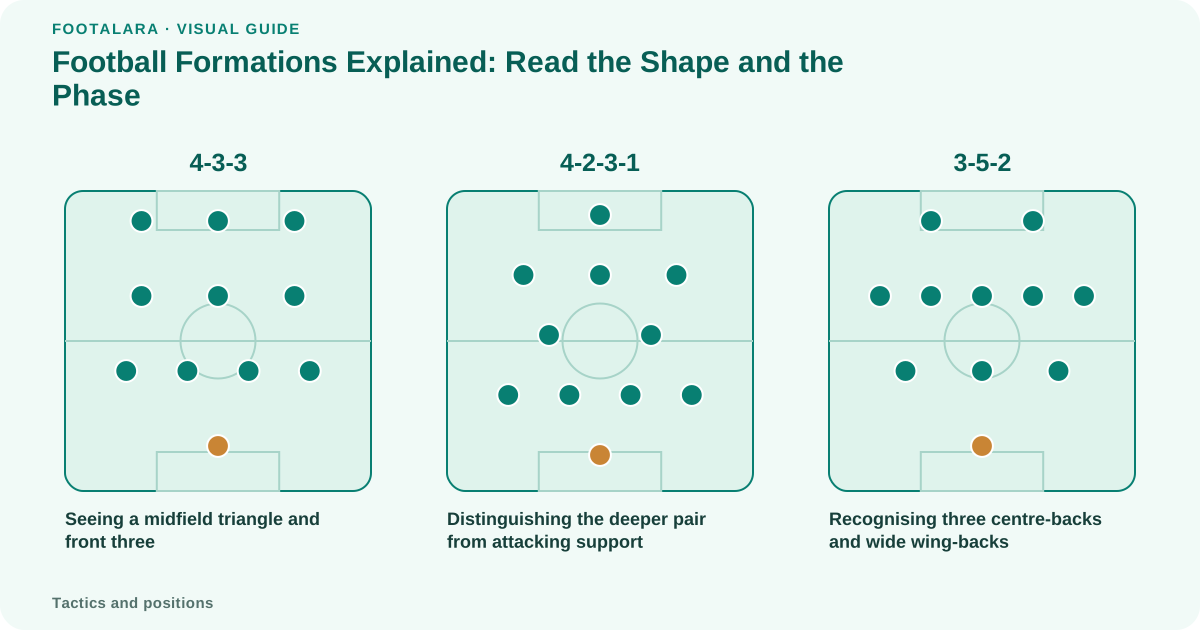
Formation numbers describe a useful starting arrangement of the ten outfield players. A 4-3-3 has four defenders, three midfielders and three forwards; its goalkeeper is usually left out of the shorthand. The numbers alone do not show where the ball is, who is pressing, or which player has moved to create a passing option.
Read from the goalkeeper towards the attack
Start with a count, then ask about jobs
In a 4-2-3-1, the two and three distinguish two midfield layers: a deeper pair and three players supporting a central forward. In a 3-5-2, the wide members of the midfield five are often wing-backs. If they recover alongside the three centre-backs, the defensive picture can resemble a 5-3-2.
These are descriptions, not Laws of the Game. IFAB requires a goalkeeper among a team's eleven players, but does not prescribe a formation. A broadcaster's graphic and a coach's description can both be useful while emphasising different moments.
Sources: IFAB — Law 3: The Players
Take three snapshots of the same team
Possession, settled defence and transition
During a controlled build-up, watch the goalkeeper, centre-backs and nearest midfielder. FIFA's Rehanne Skinner session demonstrates how support angles and wide full-backs can help a team play through pressure. Notice the available passes, rather than counting only the players nearest their nominal positions.
Next watch settled defending. FIFA's out-of-possession analysis explains how compact midfield spacing can deny central routes and encourage an opponent towards a touchline. Finally watch the instant the ball is lost: the team may still be stretched from attacking. That transition snapshot should not be mistaken for its intended defensive shape.
- Who has the ball?
- Is the team settled or recovering?
- Which space is it trying to use or protect?
Sources: FIFA Training Centre — Rehanne Skinner: Using the goalkeeper for successful build-up · FIFA Training Centre — Team organisation out of possession
A worked observation: when a full-back comes inside
One player changes the passing picture
FIFA's analysis of Chelsea at the 2025 Club World Cup describes the use of an inverted full-back to create central overloads. The label full-back still identifies the player, while the action describes movement into a midfield area. Those two statements are compatible.
Use that example as an observation task. Find the wide defender before the move, follow where he receives, and identify who now provides width. Then look behind the ball. A diagram with an arrow into midfield should also prompt the question of who covers the space that was vacated.
Sources: FIFA Training Centre — Chelsea: The inverted full-back and central overloads, 2025
Compare shapes without awarding an automatic winner
Every extra option has a cost elsewhere
A two-striker shape can offer two central targets but needs a plan for covering width. A midfield three can offer central passing angles but still be outnumbered if teammates are too far away. A back five can defend the penalty area with numbers yet leave its forwards isolated. These are questions to test in the match, not inevitable outcomes.
Pause a sequence after three passes and write a sentence instead of another formation number: 'The left-back is inside, the winger holds the touchline, and the near midfielder runs beyond.' This describes what you can actually see and gives you a better clue for the next action.
Keep a phase ledger instead of forcing one label
A worked observation of the same team in three moments
The following sequence is illustrative, not analysis of an actual match. Begin with a team listed as 3-4-3. At its goal kick, the goalkeeper stands behind three separated centre-backs, the two central midfielders offer inside, and the wing-backs stay higher and wider. Once the ball reaches the attacking half, the front three and both wing-backs can occupy five lanes while the midfield pair remain behind them. FIFA has described this 3-2-5 attacking arrangement in its analysis of Chelsea's 3-4-3, showing why a starting label and an in-possession picture can both be accurate descriptions of different moments.
Now imagine an opponent intercepts the pass into the right wing. The nearest player presses the receiver, the midfield pair protect the route through the centre, and the far wing-back begins a longer recovery towards the back line. Ten seconds later the team may defend with five across the back. Write three entries in a ledger: restart, settled attack, settled defence. Beside each entry, record the last clear event and the jobs of the two widest players. That evidence is more useful than arguing whether the team is 'really' a 3-4-3, 3-2-5 or 5-4-1.
- Restart: count the first passing line and the players offering beyond it.
- Settled attack: identify who supplies width and who remains behind the ball.
- Settled defence: wait for recovery, then count the lines again.
Sources: FIFA Training Centre — Chelsea's principles of attack in a 3-4-3 system
Separate a temporary picture from a settled structure
Use the event before the screenshot as evidence
A freeze-frame immediately after possession changes can show players between jobs. The winger who lost the ball may be deeper than the full-back; a centre-back may still be in midfield after carrying forward; the far-side players may already be narrowing. Calling that instant a new formation hides the reason for their positions. First identify whether the team is attacking, losing the ball, recovering, or organised without it. Then watch until the movement slows enough to reveal stable lines.
FIFA's defending work describes coordinated movement: the nearest midfielder moves towards the attacker, the others follow, and the far midfielder tucks in. That is a useful test when reviewing a clip. If players shift together in response to the ball, you are seeing a team principle. If one player is merely stranded after the turnover, their location is weak evidence of a planned role. Record the movement and the trigger before assigning a new numerical label.
Sources: FIFA Training Centre — Michael Johnson: Defending principles for individuals and small groups
Choose what the extra attacker costs
Choose the priority: width, central presence or protection
Suppose both wide defenders join the highest line. The attack can stretch the opposition across the pitch and place more receivers near the penalty area. The tradeoff appears behind the ball: fewer players are immediately available to slow a counterattack into a vacated flank. Holding one wide defender deeper gives stronger protection and a safer recycling pass, but it may leave the far winger isolated or make a switch less threatening.
Treat this as a choice to judge, not a universal rule. Pause before the final pass and count three things: high players, central protectors, and opponents positioned to counter. Then predict where the first defensive action would occur if the team lost possession. FIFA's Chelsea analysis connects high wing-backs with midfield protection, while its goal-kick framework shows that teams can progress around, through, into, onto, or beyond pressure. A formation explanation becomes useful when it links the chosen route to the space that choice leaves behind.
Sources: FIFA Training Centre — Chelsea's principles of attack in a 3-4-3 system · FIFA Training Centre — Building from goal kicks
Quick comparison
| Concept | Useful for | Watch for |
|---|---|---|
| 4-3-3 | Seeing a midfield triangle and front three | Wingers may recover into midfield |
| 4-2-3-1 | Distinguishing the deeper pair from attacking support | One midfielder may move into another line |
| 3-5-2 | Recognising three centre-backs and wide wing-backs | Recovery can produce a line of five |
A three-frame match notebook
- Draw the side during a goal-kick build-up.
- Draw it again after the opponent has circulated the ball for several passes.
- Mark the players nearest the ball immediately after a turnover.
- Explain one difference using a player's movement, not just a new number.
Practical checklist
- Count ten outfield players
- Identify the phase
- Track one rotation
- Check the space left behind
Test your understanding
Try each question before opening the answer. Use the explanation to check your reasoning.
An attacking team appears as a 3-2-5, loses the ball, and has one wing-back still sprinting towards the defensive line. Is that first recovery frame enough to call its defensive formation a 5-4-1?
Show answer and explanation
No. Wait for the team to settle and use the players' coordinated recovery as evidence.
The first frame records a transition. Note who presses, who protects the centre, and where the far-side player recovers before describing the settled defensive lines.
Both wide defenders advance. What two details should you check before calling the choice more attacking?
Show answer and explanation
Check who now provides width near the ball and who remains positioned to delay a counterattack.
The extra high player may improve access or stretch the defence, but the tactical judgment also depends on the protection left behind.
Frequently asked questions
Which formation is the most attacking?
No formation wins that label in every match. Observe the players committed forward, their support distances and the cover behind them in a particular match.
Conclusion
Use a formation to start reading a team, then add the phase and each player's movement. The most helpful sketch explains both an available pass and the space the team must protect.
Sources
- IFAB — Law 3: The Players
- FIFA Training Centre — Rehanne Skinner: Using the goalkeeper for successful build-up
- FIFA Training Centre — Team organisation out of possession
- FIFA Training Centre — Chelsea: The inverted full-back and central overloads, 2025
- FIFA Training Centre — Chelsea's principles of attack in a 3-4-3 system
- FIFA Training Centre — Michael Johnson: Defending principles for individuals and small groups
- FIFA Training Centre — Building from goal kicks