Best Football Memory Games: Four Exercises to Try
Choose between lineup recall, timeline ordering, clue comparisons and answer explanation, with a short exercise for each.
Introduction
The best memory game depends on what you want to retrieve. Remembering a player from a photograph, reconstructing an eleven and explaining a tournament route are different tasks. These four exercises let you practise a specific weakness with a sheet of paper or a Footalara game, without needing a paid tool or a larger question bank.
1. The disappearing lineup
For missing names and misplaced substitutes
Choose one verified starting eleven, study it briefly, then close the source. Draw the team from memory. Open the answer only when you have stopped adding names. Repeat with the names hidden but your positional sketch still visible, and finally without either aid.
Change only one difficulty at a time. Begin with a familiar team, then choose a less familiar season; do not simultaneously shorten the viewing time and change the competition. Keep two counts: correct starters and false inclusions. Guess the Lineup is a useful place to apply the same habit to a match selected for you.
2. Three finals in order
For dates that keep swapping places
Make three cards: Marseille beat Milan with a Basile Boli goal; Ajax beat Milan with a Patrick Kluivert goal; Manchester United beat Bayern with late goals from Teddy Sheringham and Ole Gunnar Solskjær. Put the cards in chronological order before checking the dates.
The answer is 1993, 1995, 1999. Now turn each card over and supply the winning club from the year alone. This second direction matters: recognising an event when its whole story is provided is easier than retrieving the story from a short cue.
Sources: UEFA — 1992/93: French first for Marseille · UEFA — 1994/95: Kluivert strikes late for Ajax · UEFA — Solskjær recalls the 1999 final
3. The near-miss pair
For answers that sound equally plausible
Pick an error from your last quiz and make a two-column card. Put your answer on the left and the correct answer on the right. Underneath, write the smallest fact that separates them: different final, different season, starter rather than substitute, or club rather than national team.
For example, use the two Milan defeats above. Boli belongs to Marseille's 1993 victory; Kluivert belongs to Ajax's 1995 victory. A card labelled only 'scored against Milan in a final' cannot reliably distinguish them. Repair the clue as well as learning the answer.
Sources: UEFA — 1992/93: French first for Marseille · UEFA — 1994/95: Kluivert strikes late for Ajax
4. Explain the answer before the reveal
For lucky guesses
After choosing an answer, say why it fits and why the nearest alternative does not. Award one point for the answer and another for the explanation. A correct guess with no reason is a useful starting point, but should stay in your review pile.
In a group, let one person read the question while another records explanations. Rotate roles. Do not let the fastest voice erase everyone else's retrieval attempt: each player writes privately first. This makes the game more useful for a beginner sitting beside an experienced fan.
Build a small repeatable session
Measure what survives the delay
A six-minute session can contain one lineup attempt, the three-card timeline and two near-miss cards. Revisit the errors on another day before adding new material. Retrieval and spacing research provides the learning rationale, but this particular routine is a practical suggestion, not a scientifically tested football programme.
Choose accuracy as your first measure. Add a timer only once you can explain your answers. If a game repeatedly produces mistakes that you never inspect, lower the difficulty or reduce the number of questions so there is time to learn from them.
Sources: Roediger and Karpicke (2006) — Test-enhanced learning · Cepeda and colleagues (2006) — Distributed practice in verbal recall tasks
Quick comparison
| Concept | Useful for | Watch for |
|---|---|---|
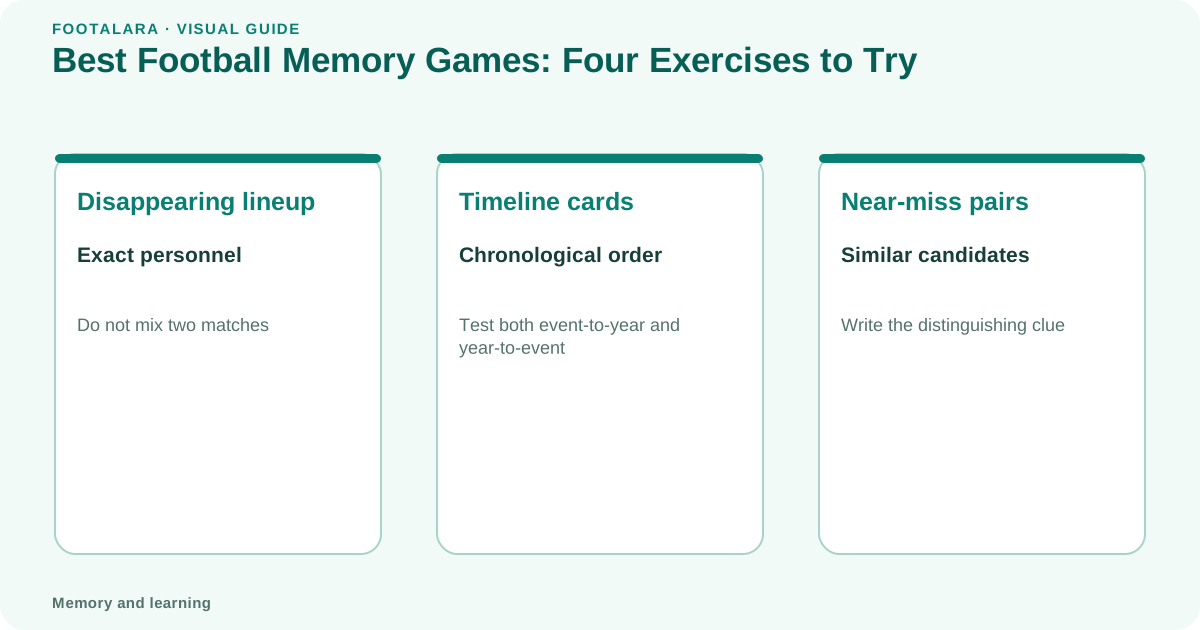
| Disappearing lineup | Exact personnel | Do not mix two matches |
| Timeline cards | Chronological order | Test both event-to-year and year-to-event |
| Near-miss pairs | Similar candidates | Write the distinguishing clue |
| Answer explanation | Checking understanding | Separate knowledge from a lucky guess |
A session using three finals
- Order Marseille–Milan, Ajax–Milan and United–Bayern.
- Check 1993, 1995 and 1999 in the linked reports.
- Give each winning club when shown only the year.
- Review any swapped pair on another day.
Practical checklist
- Choose one memory weakness
- Answer before revealing
- Explain the closest wrong answer
- Revisit a small set of errors
Frequently asked questions
Does a longer session guarantee better memory?
No. Track later recall rather than minutes spent looking at answers. A manageable set with feedback is a better starting point than an unfinished pile of questions.
Conclusion
Match the exercise to the error. Lineups test exact membership, timelines test sequence and contrast cards test distinctions. Keep the feedback and the later attempt part of the game.