How to Remember Football Lineups Faster
Reconstruct Liverpool's 2005 final XI, separate famous substitutes from starters, and turn one missed name into a useful memory cue.
Introduction
A lineup question asks who began one exact match. It does not ask for the club's best eleven, the players who finished the match, or everyone who scored. Those distinctions make Liverpool's 2005 Champions League final an unusually good practice exercise: some of its most memorable contributors began on the bench.
Try the exercise before reading the answer. Draw eleven empty circles, write Milan v Liverpool, Istanbul, 25 May 2005 above them, and spend ninety seconds adding names. Mark uncertain answers with a question mark instead of silently treating a familiar name as certain.
Check the exact eleven
An answer key with a separate bench
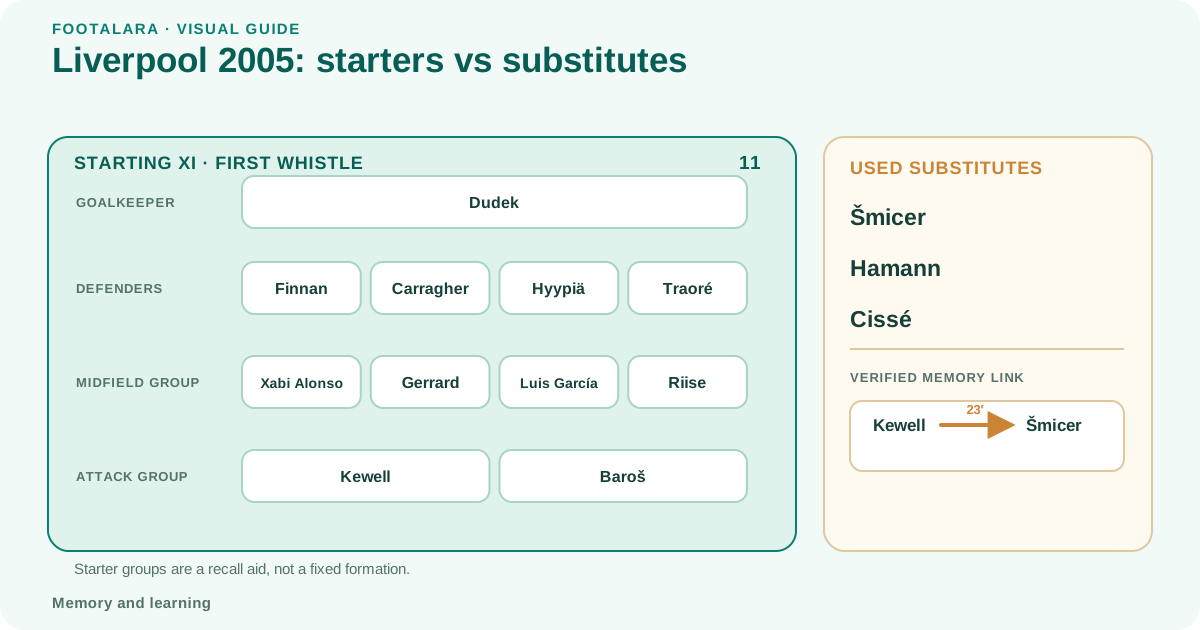
UEFA's match sheet lists Jerzy Dudek; Steve Finnan, Jamie Carragher, Sami Hyypiä, Djimi Traoré; Xabi Alonso, Steven Gerrard, Luis García, John Arne Riise; Harry Kewell and Milan Baroš as Liverpool's starters. This grouping helps you count the names; those groups do not imply that every player remained in those lines throughout the match.
Vladimír Šmicer, Dietmar Hamann and Djibril Cissé entered as substitutes. Put them in a different box on your paper. A correct memory of Šmicer scoring is compatible with an incorrect answer if you put him in the starting eleven.
Sources: UEFA — Milan v Liverpool, official 2005 final line-up sheet
Use the mistake to create a stronger cue
Remember the replacement as a relationship
Kewell went off injured and Šmicer replaced him after 23 minutes. Instead of memorising Kewell again as an isolated word, attach the correction to the event: Kewell starts, injury, Šmicer enters. The very highlight that caused the error can become the route back to the correct answer.
Treat other errors just as specifically. If you recalled a Liverpool player from a different season, write the two seasons side by side. If you omitted a full-back, connect him to the centre-back beside him. Each correction should explain why your first answer was attractive and what rules it out.
Rebuild in three passes
A routine for your next lineup
First recover the goalkeeper and centre-back pair. Then fill the remaining positions using partnerships, sides of the pitch and the match context. Finally count eleven and check every name against the first whistle. Leave a gap if you cannot distinguish a starter from a substitute.
You can score the attempt without rewarding guesses: one point for each correct starter, then separately count false inclusions. Nine correct names with no invented starter tells you something different from nine correct names buried in a list of fifteen. Aim to improve both measures.
- Record correct starters out of eleven.
- Record false inclusions separately.
- Choose one cue for the hardest missing name.
Return when the answer is less familiar
Recall is different from recognising a list
Research on retrieval practice and distributed practice supports testing memory and returning after a delay. Those studies concern learning more generally; they do not establish a special football schedule or guarantee a particular gain.
A practical starting routine is a fresh attempt tomorrow and another later in the week. Hide the answer key each time. If you immediately reproduce eleven names only while looking at the same page, you have not yet tested whether the match cue can retrieve them on its own.
Sources: Roediger and Karpicke (2006) — Test-enhanced learning · Cepeda and colleagues (2006) — Distributed practice in verbal recall tasks
Compare the same fixture two years apart
Five repeat starters make a frame for six changes
UEFA's official sheets give two exact Liverpool elevens against Milan. In Istanbul in 2005, Liverpool started Jerzy Dudek; Steve Finnan, Jamie Carragher, Sami Hyypiä and Djimi Traoré; Steven Gerrard, Xabi Alonso, Luis García and John Arne Riise; Harry Kewell and Milan Baroš. In Athens in 2007, they started Pepe Reina; Finnan, Carragher, Daniel Agger and Riise; Gerrard, Alonso, Jermaine Pennant, Javier Mascherano and Boudewijn Zenden; and Dirk Kuyt. The five names present at both kick-offs are Finnan, Carragher, Riise, Gerrard and Alonso.
Use those five as the stable frame, then retrieve the six 2005-only starters and the six 2007-only starters. This is more demanding than recognising either team from a list because each familiar Liverpool name needs the correct final. A practical card has the shared five down the centre and the two sets of six on opposite sides. Cover one side, rebuild it, and count to eleven before checking.
Finish by shuffling the twelve season-specific names and sorting them into 2005 or 2007. Then add the shared five to each pile and verify that both teams reach eleven. This tests the boundary between the finals instead of inviting recognition from a complete lineup.
- Shared starters: Finnan, Carragher, Riise, Gerrard, Alonso.
- 2005-only starters: Dudek, Hyypiä, Traoré, Luis García, Kewell, Baroš.
- 2007-only starters: Reina, Agger, Pennant, Mascherano, Zenden, Kuyt.
Sources: UEFA — Milan v Liverpool, official 2005 final line-up sheet · UEFA — Milan v Liverpool, official 2007 final line-up sheet
Track a player across starter and bench columns
Status changes are stronger cues than another name list
Now compare roles on the two documents rather than only the elevens. Dudek, Hyypiä and Kewell all started the 2005 final but appear among Liverpool's substitutes in 2007. Finnan, Carragher, Riise, Gerrard and Alonso remain starters. That creates two clear memory relations: three players move from the starting column to the bench column, while five keep starting status across both finals.
Encode the relation explicitly. Write S05 beside Dudek, then B07; do the same for Hyypiä and Kewell. For the stable five, write S05/S07. On the next attempt, ask two questions in sequence: who was in the 2005 XI, and what was that player's status in 2007? This catches a common error that a single-match drill cannot reveal: remembering a real participant but assigning him to the wrong season or status.
For the final pass, cover the names and use only the codes as prompts. S05/B07 must retrieve Dudek, Hyypiä and Kewell; S05/S07 must retrieve the stable five. A wrong name now identifies the exact relation to review rather than sending you back to memorise both full sheets.
- Mark S for starter and B for bench.
- Attach each mark to a season.
- Test the direction both ways: player to status, then status to player.
Sources: UEFA — Milan v Liverpool, official 2005 final line-up sheet · UEFA — Milan v Liverpool, official 2007 final line-up sheet
Quick comparison
| Concept | Useful for | Watch for |
|---|---|---|
| Kewell | Starting-XI answer | His early injury does not remove him from the eleven |
| Šmicer | Substitution and scoring memory | A goal is not evidence of a start |
| Hamann | Second-half change | The comeback side differs from the starting side |
Repair one false memory
- Write your eleven before opening UEFA's match sheet.
- Circle every name that appears only among the substitutes.
- Replace the wrong name with the actual starter and record their connection.
- Hide the sheet and retrieve that pair tomorrow.
Practical checklist
- Identify one exact match
- Separate starters and substitutes
- Explain the most tempting error
- Repeat without the answer key
Test your understanding
Try each question before opening the answer. Use the explanation to check your reasoning.
Which five Liverpool players started both the 2005 and 2007 finals against Milan?
Show answer and explanation
Steve Finnan, Jamie Carragher, John Arne Riise, Steven Gerrard and Xabi Alonso.
Comparing UEFA's two starting columns leaves exactly those five names in the overlap.
Name three 2005 Liverpool starters who appear among the 2007 substitutes.
Show answer and explanation
Jerzy Dudek, Sami Hyypiä and Harry Kewell.
Each appears in the 2005 starting XI and in the 2007 bench list, so the season and status both matter.
Frequently asked questions
Must I memorise the formation as well?
Use a shape to organise names, but check the exact starters independently. Sources can describe the same fluid team with different formation labels.
Why use this final instead of a random match?
Its familiar substitutes make it easy to detect the difference between remembering the story and remembering the starting XI.
Conclusion
Keep the match fixed, separate the bench and correct the reason behind each mistake. The useful result is an eleven you can reconstruct later, with fewer confident false memories.