How Footalara Similarity Scores Work
Read the percentage in Guess the Player II correctly, use career connections to choose the next guess, and avoid treating a similarity score as a probability.
Introduction
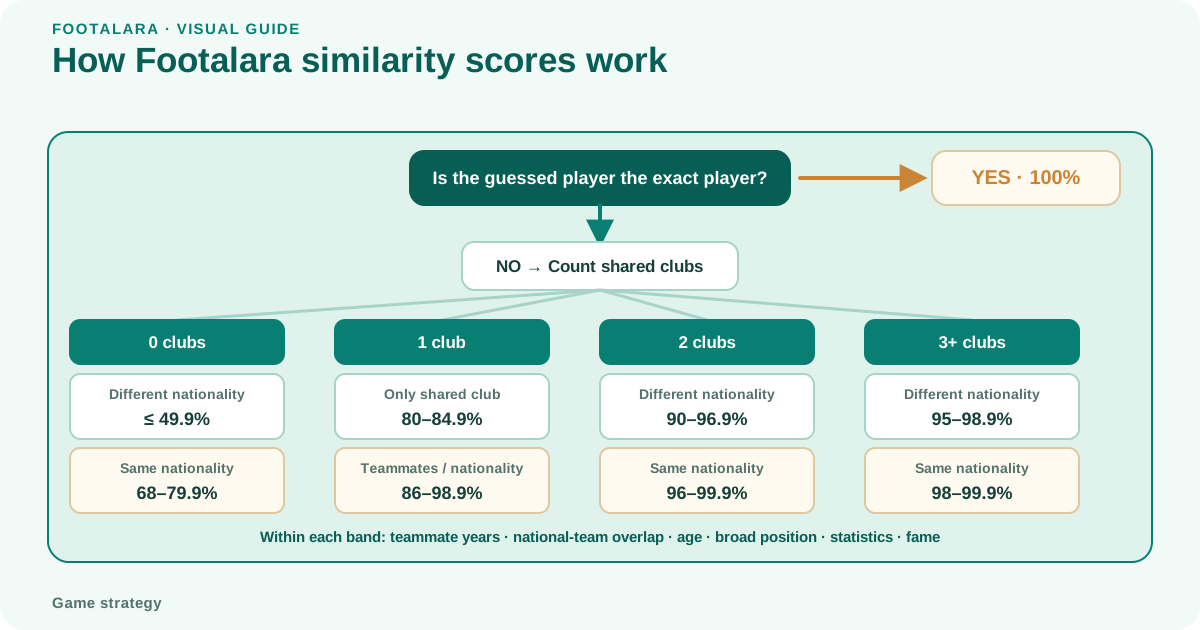
Guess the Player II compares your guess with a hidden footballer. A higher percentage means a closer match under Footalara's scoring rules. The percentage describes neither an ordinal rank where a smaller number is better nor the probability that your guess is correct. The exact answer reaches 100%; a different player can be very close and still be wrong.
Start with career connections
Shared clubs carry the strongest basic signal
The current scoring implementation first distinguishes shared club history and nationality, then whether the players were teammates. Playing for the same club at different times is a connection; playing together adds a different kind of evidence. More shared clubs strengthen the connection further.
Age, position and statistical profile refine the comparison within those groups. They do not let an unrelated player reach the highest scores simply because both players are famous forwards. Use a high result to investigate a football relationship before jumping to another globally famous name.
Read broad bands without inventing certainty
A percentage is a clue, not an answer key
In the current model, a pair with no shared club and different nationalities remains below 50%. The same nationality without a shared club reaches a higher band but remains below 80%. One shared club starts a stronger band, while actual overlap as teammates, nationality and further shared clubs can lift the score further.
These bands describe the information recorded in the game's data. They do not prove every real-world relationship has been captured, and they are not a public ranking of how similar players are in every football sense. A score cannot tell you the hidden name without further reasoning.
Make the next guess test a hypothesis
An illustrative three-guess sequence
Imagine your first guess gives a moderate result and you suspect a nationality connection. Choose a second player from that nationality with a different club history. If the score falls sharply, nationality alone may not explain the first result. Investigate the first player's clubs instead.
For the third guess, choose someone connected to one of those clubs, preferably with a clearly different career elsewhere. This changes a meaningful part of the comparison. Three near-identical guesses from the same squad may all score well while doing little to separate the possible explanations.
This sequence is a strategy example, not a prediction of exact scores for named players. The hidden answer and the available career data determine the actual results. Record what each guess tested so the next decision uses evidence rather than only the latest colour or number.
A very high score still needs a final distinction
Find the part of the careers that diverges
When two different candidates are both close, compare the club they did not share, the timing of their careers, their nationality and their role. The best next clue may be the one difference between two plausible names, rather than another similarity between them.
Do not read 95% as a 95% chance of having identified the answer. The game has already compared a specific wrong guess with a specific hidden player. The percentage summarises the relationship; only the exact player resolves the challenge.
Review data surprises precisely
Report the pair and the relationship
If a result seems inconsistent, note the guessed player, the revealed answer and the relationship you expected the game to recognise. A club name, approximate overlap dates and a reliable source are more actionable than saying that two players ought to feel similar.
Career datasets can contain missing spells, naming differences or incomplete teammate overlap. A surprising score is a reason to inspect the relevant facts, not proof that your next guess must follow the same assumption. Use Footalara's contact page to send a reproducible correction after the answer is known.
Use a hypothesis table after every guess
A worked example without invented real-player scores
Imagine an unnamed hidden player and three candidates A, B and C. Candidate A returns a relatively high similarity score. That result can have several explanations: shared club history, nationality, teammate overlap or smaller profile adjustments. Write A's known clubs in one column and nationality in another. Candidate B should share the nationality but not A's obvious club link; candidate C should have the club link but a different nationality. You are not trying to guess the exact numbers in advance. You are setting up contrasting observations that can help distinguish the leading explanations.
If B falls far below A while C remains close, investigate the shared club or teammate relationship before spending another guess on nationality alone. If the reverse happens, re-examine the nationality connection and any other recorded overlap. If both remain close, the clues have not yet separated the candidates; choose a fourth player who changes another major attribute. A score is evidence about one pair under this game's data, not a mathematical probability assigned to your entire list of possible answers.
Keep a compact log: guess, observed score, strongest known link, next contrast, and what changed. After the reveal, compare the recorded links with the actual answer. A surprise may expose a mistaken assumption about career overlap or a dataset detail worth reporting. Resist writing 'the game thinks these players are the same' when it merely assigned a high but non-exact score. The only decisive result is the exact hidden player.
Distinguish a shared club from a shared dressing room
The timing of careers changes what a link means
Two footballers can have played for the same club in entirely different eras. That gives them a club-history connection but does not make them former teammates. Write the club and the approximate seasons beside each player before using the word teammate. If their periods do not overlap, a teammate inference is false even though the badge matches. The distinction matters because Footalara's comparison separates shared club history from actual overlap as teammates.
Now reverse the problem. Two players might have played together at more than one club, or share nationality and one club, creating several related signals. A large percentage need not reveal which of these ingredients had the biggest effect without checking the underlying careers. Position and age refine a comparison; they should not be used to override contradictory club histories. When a high result surprises you, identify the simplest verifiable relationship first, then refine it with dates and role.
After a completed round, prepare a three-row review: a pair sharing only nationality, a pair sharing a club in different years, and a pair who actually overlapped. Do not fabricate precise percentages for those rows because the model also uses other inputs and the specific records matter. The exercise is to predict the direction and relative strength of the links, then compare with the displayed results. If the outcome differs, inspect the data and report a reproducible pair through the contact route.
What a percentage cannot tell you
Avoid three interpretations that waste guesses
First, 87% is not an 87% chance that your guess is the answer. The game has already evaluated a particular pair; the number measures its modelled closeness. Second, a rise from one guess to the next is not proof that you have found the correct club. Nationality, teammate overlap and other attributes may have changed at the same time. Third, equal rounded percentages do not imply two candidates have identical careers. Different combinations of features can meet at the same displayed value.
A disciplined next guess changes one major hypothesis where possible. If the first two candidates are former teammates, try someone from the same club who never overlapped with one of them. If both candidates share a nationality, test a player from that nationality with a distinct club path. The game remains a football knowledge challenge rather than a perfect controlled experiment, so you cannot hold every variable fixed. You can still make each guess answer a specific question and record what remains unresolved.
Review one finished round as an experiment
A worked exercise with a checkable answer
After the hidden player is revealed, list your guesses in order, their displayed scores and the reason you chose each name. Put the actual answer's club history and nationality beside that list. Circle guesses that tested a distinct hypothesis; mark near-identical guesses that added little information. This review is more useful than remembering only whether you won. A high-scoring wrong answer may have pointed to a real career connection, while a low-scoring guess may have ruled out a broad theory.
Now select the most surprising comparison and check three possible explanations. Did the guessed player and answer share a club at different times? Did their time there overlap enough to make them teammates? Did another recorded attribute contribute? Do not treat a missing relationship in a dataset as a statement about the whole of football history. If you believe the game missed a genuine link, include the exact pair, club and approximate dates in a correction request after checking a reliable record.
Before starting the next daily round, write one rule learned from this review, such as 'test club overlap separately from nationality' or 'a high percentage is not a probability'. That one specific rule changes your next guess more than a long list of famous names. The game rewards narrowing explanations, and the score only becomes informative when you compare it with the hypothesis you meant to test.
Quick comparison
| Concept | Useful for | Watch for |
|---|---|---|
| Shared club history | Choosing a connected career to investigate | Different years do not necessarily mean teammates |
| Nationality | Testing a broad relationship | Nationality alone does not create a near-perfect score |
| Position and age | Refining plausible candidates | Secondary similarities do not replace career links |
| 100% | Recognising the exact answer | A different player may approach this without solving the game |
Keep a short guess log
- After guess one, write the career or nationality connection you suspect.
- Choose guess two to change one major part of that hypothesis.
- Compare the direction of the score change.
- Use guess three to distinguish the remaining explanations, then review after the reveal.
Practical checklist
- Read higher as closer
- Check career links first
- Test one hypothesis per guess
- Distinguish close from exact
Test your understanding
Try each question before opening the answer. Use the explanation to check your reasoning.
If two footballers played for the same club ten years apart, have you established they were teammates?
Show answer and explanation
No. You have established a shared-club link, not overlapping service.
Check the seasons separately before inferring teammate overlap; the similarity model treats these as distinct kinds of connection.
Does an 87% score mean your candidate has an 87% probability of being the hidden answer?
Show answer and explanation
No.
It is a similarity measure for one compared pair, not a probability of correctness.
Frequently asked questions
Is a lower similarity rank better?
The game displays a percentage score: higher means closer. The guide's existing URL contains the word ranks, but the percentage is not a numbered leaderboard position.
Can two players have the same score?
Yes. Several relationships can produce the same rounded percentage. A tied score does not mean the players have identical careers or that either one is necessarily the answer.
Conclusion
Use the percentage to test football connections. Shared careers guide the search, deliberate contrasts narrow it, and the exact answer remains distinct from even a very strong similarity.