Famous Football Teams: Three Eras, Three Ways to Remember Them
Build a match-based memory of Real Madrid in 1960, Ajax in 1971–73 and Barcelona in 2011 without mixing their players or coaches across eras.
Introduction
A club name can cover a century of different teams. For a historical lineup or quiz, narrow the name to an era and then one match. The following three European champions are useful starting points because each supplies a different memory problem: sharing goals between stars, following a coaching handover, and separating a celebrated squad from the eleven that actually started.
Real Madrid, 1960: divide the seven goals
Two famous names, different answers
Real Madrid beat Eintracht Frankfurt 7–3 in the 1960 European Cup final. Ferenc Puskás scored four goals and Alfredo Di Stéfano three. Make those numbers the anchor for this particular team before adding other names. A question about a hat-trick and a question about four goals lead to different players even though both refer to the same match.
For your notebook, write the opponent and score at the top, then put Puskás and Di Stéfano in separate columns. Reconstruct the scoring contribution from the total: four plus three explains Madrid's seven. That small check helps catch the familiar-name error in which you recall the right stars but attach the wrong detail.
Ajax, 1971–73: remember the handover
An era is longer than one coach's tenure
Ajax won three consecutive European Cups, defeating Panathinaikos in 1971, Inter in 1972 and Juventus in 1973. Rinus Michels coached the first success before moving to Barcelona. Stefán Kovács then oversaw the next two. Associating the whole run only with Michels misses that change.
UEFA describes the team's positional exchanges, pressure and use of width within a 4-3-3. Turn that description into a viewing question: when one player moves away from his starting area, who occupies the space? The point is to observe a coordinated exchange, rather than imagine that Total Football meant everyone wandering freely.
Draw three boxes, one for each final. Add the opponent first and the coach second. Keep the 1995 Ajax winners on a separate page: they belong to a later team, even though the same club name appears on the trophy.
Sources: UEFA — Ajax 1971–73
Barcelona, 2011: verify the starting side
A famous defender is not automatically a starter
Barcelona defeated Manchester United 3–1 at Wembley in the 2011 final. Pedro, Lionel Messi and David Villa scored for Barcelona; Wayne Rooney scored for United. UEFA's report identifies Javier Mascherano starting in central defence in place of Carles Puyol, with Éric Abidal at left-back.
That detail is especially useful for a lineup exercise. If you begin from a mental list of Barcelona legends, Puyol is an easy inclusion. If you begin from this match's record, you have to explain the actual selection. Treat fame as a prompt to check, not as evidence of a start.
Sources: UEFA — Barcelona crowned as Messi and Villa see off United
Build an era card you can actually test
One match is enough for the first pass
Give each card five fields: club, season, coach, anchor match and one easily confused detail. Hide the last two fields and retrieve them from the first three. On the next attempt, reverse the direction: read the match detail and identify the era.
These examples are a learning selection, not a worldwide popularity ranking. You can use the same card for a women's team, a national side or a club outside Europe. Choose a verifiable match and state the competition clearly so the question can be answered on its own terms.
Nottingham Forest, 1979–80: continuity with three changes
Back-to-back winners were not a frozen eleven
UEFA's final records show Nottingham Forest beating Malmö 1–0 in 1979 and Hamburg 1–0 in 1980. Eight players started both finals: Peter Shilton, Viv Anderson, Larry Lloyd, Kenny Burns, John McGovern, Ian Bowyer, Garry Birtles and John Robertson. Frank Gray, Martin O'Neill and Gary Mills took the three places held in 1979 by Frank Clark, Trevor Francis and Tony Woodcock. Francis scored the 1979 winner; Robertson scored the 1980 winner.
This makes the Forest side useful for understanding an era without turning it into one permanent lineup. The repeated eight give the era continuity, while the three changes stop the memory card becoming a generic list of everyone associated with both trophies. A strong description can name the shared spine, identify the changing places and attach each final to its own scorer and opponent.
Build the comparison from an eight-name centre column and two three-name side columns. Add Malmö and Francis to the 1979 side, then Hamburg and Robertson to the 1980 side. On review, retrieve the opponent, scorer and three changing starters before filling the shared eight.
- 1979: Forest 1–0 Malmö; Francis scored.
- 1980: Forest 1–0 Hamburg; Robertson scored.
- Eight starters appeared in both finals.
Sources: UEFA — official European Cup history records for the 1979 and 1980 finals
Porto, 1987 and 2004: one club, two separate teams
Seventeen years remove the temptation to build an all-era XI
Porto's two European Cup-winning finals provide the opposite memory pattern. The 1987 starting XI against Bayern and the 2004 starting XI against Monaco share no players. In Vienna, Porto came from behind to win 2–1: Rabah Madjer equalised and half-time substitute Juary scored the winner. In Gelsenkirchen, Porto beat Monaco 3–0 through Carlos Alberto, Deco and substitute Dmitri Alenichev. UEFA's 2004 sheet records Alenichev on the bench and Carlos Alberto in the starting eleven.
Use different era markers for the two wins. For 1987, attach Artur Jorge, Bayern, Madjer and the substitute Juary. For 2004, attach José Mourinho, Monaco, the starting midfield core of Costinha, Maniche, Pedro Mendes and Deco, and the Carlos Alberto-to-Alenichev change. The shared badge links the stories, while the dates and lineups keep their personnel separate.
Both finals also warn against treating scorers as an automatic starting XI. Juary and Alenichev scored after beginning on the bench. Make that parallel the retrieval prompt, then supply the year, opponent and starter whom each scorer replaced.
- 1987 anchor: Bayern, 2–1, Madjer and substitute Juary.
- 2004 anchor: Monaco, 3–0, Carlos Alberto, Deco and substitute Alenichev.
- No starter appears in both Porto final XIs.
Sources: UEFA — official European Cup history record for Porto v Bayern, 1987 final · UEFA — Monaco v Porto, official 2004 final line-up sheet
Quick comparison
| Concept | Useful for | Watch for |
|---|---|---|
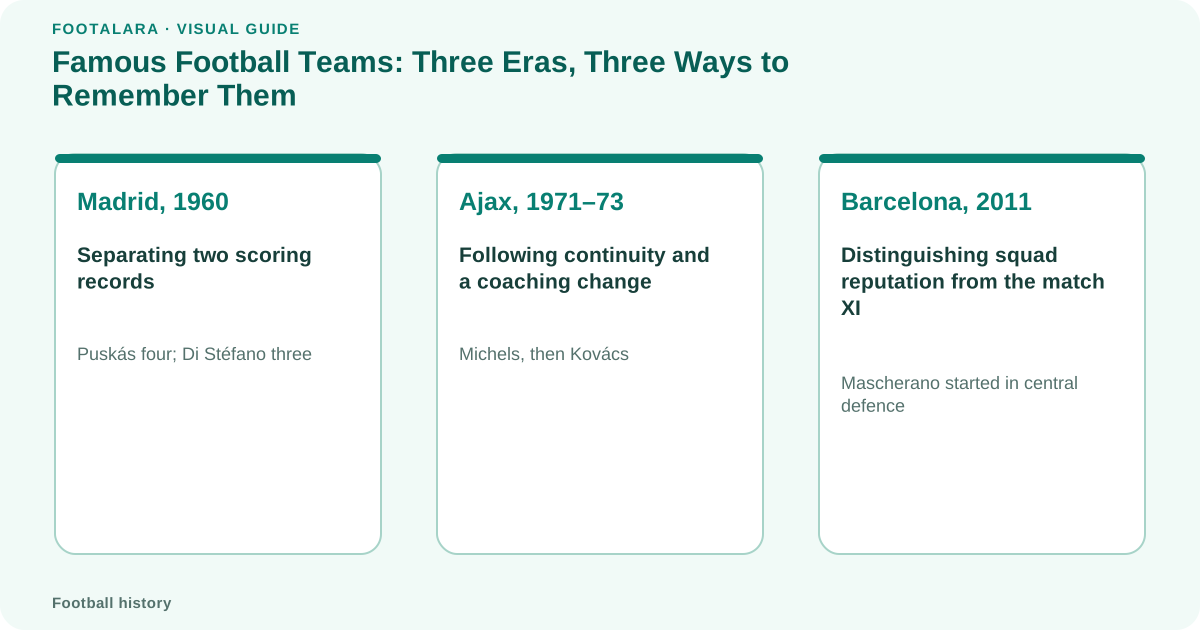
| Madrid, 1960 | Separating two scoring records | Puskás four; Di Stéfano three |
| Ajax, 1971–73 | Following continuity and a coaching change | Michels, then Kovács |
| Barcelona, 2011 | Distinguishing squad reputation from the match XI | Mascherano started in central defence |
Catch an era mix-up before it becomes a quiz answer
- Write Ajax 1971–73 on a card.
- List Panathinaikos, Inter and Juventus in final order.
- Place Michels beside 1971 and Kovács beside 1972 and 1973.
- Move anything about the 1995 final to a different card.
Practical checklist
- Specify the era
- Choose one anchor match
- Check coach and starters
- Record one tempting mix-up
Test your understanding
Try each question before opening the answer. Use the explanation to check your reasoning.
Which eight Nottingham Forest players started both the 1979 and 1980 European Cup finals?
Show answer and explanation
Peter Shilton, Viv Anderson, Larry Lloyd, Kenny Burns, John McGovern, Ian Bowyer, Garry Birtles and John Robertson.
Those are the names common to UEFA's two Forest starting elevens; the other three places changed.
What documented scorer-status parallel links Porto's 1987 and 2004 final wins?
Show answer and explanation
A substitute scored in each: Juary in 1987 and Dmitri Alenichev in 2004.
The official records place both players outside the starting XI and record their goals after they entered.
Frequently asked questions
Are these the three most famous teams in the world?
No popularity measure is being claimed. They are three documented examples with distinct lessons for football history and lineup recall.
Conclusion
Remember a particular team through a particular match. Dates, opponents and selection details make a club's history usable in a quiz, while a list of famous names can blur several eras together.
Sources
- UEFA — 1959/60: Dazzling Madrid crush Frankfurt
- UEFA — Ajax 1971–73
- UEFA — Barcelona crowned as Messi and Villa see off United
- UEFA — official European Cup history records for the 1979 and 1980 finals
- UEFA — official European Cup history record for Porto v Bayern, 1987 final
- UEFA — Monaco v Porto, official 2004 final line-up sheet