How Managers Choose a Starting XI: A Worked Selection Exercise
Choose between two fictional full-backs to see how an opponent, a winger and the cover behind an attack can change a lineup decision.
Introduction
Picking a starting XI is a problem of fitting players together for one match. To explore it, consider two fictional right-backs. Alex is comfortable offering short central passes. Ben is stronger at repeated runs along the touchline. Both are available and equally familiar with the team. Which should start? The useful answer begins with the other ten players and the opponent.
Start with the problem the team must solve
A choice needs a match context
In our first scenario, the opponent presses the goalkeeper and centre-backs while leaving space outside. Your right winger likes to move inward. Ben's wide runs might create an outlet and occupy the space the winger leaves. That makes a coherent attacking pair, but the selection argument still needs a defensive plan.
In a second scenario, the winger stays wide and the opponent leaves a central passing lane. Alex's ability to move inside could offer support without putting two teammates in the same wide corridor. These are hypothetical options, not a claim about a real coach's private reasoning.
Check the relationship, not just the individual
Who offers the next pass?
FIFA's build-up session with Rehanne Skinner gives a concrete coaching reference for using the goalkeeper, central support and width to play through pressure. Its value for a selection exercise is the question it suggests: which player can make the next pass possible in the pattern you want to use?
Draw a triangle between your right-back, right winger and nearest midfielder. Place the ball at each corner in turn. If one of the other two options is always blocked, change a position or a task before deciding that the individual player is the problem. An impressive isolated attribute cannot fix every spacing issue.
Sources: FIFA Training Centre — Rehanne Skinner: Using the goalkeeper for successful build-up
Test what happens after a turnover
The attacking choice has a defensive cost
Send Ben forward in the first scenario and imagine a misplaced pass. Who delays the opponent on that side? If the nearest midfielder is also in the penalty area, the team may need a different supporting instruction. Choosing the attacking runner and choosing the cover are parts of the same decision.
FIFA's out-of-possession analysis emphasises compact organisation and control of central space. Use that as a second check on your paper XI: can the team recover into connected distances, or have you assigned several players tasks that leave them too far apart? This evaluates the plan rather than assuming a more defensive position label guarantees safety.
Sources: FIFA Training Centre — Team organisation out of possession
Plan the bench before the first whistle
A substitute can have a specific later job
Being left out of the starting eleven does not mean a player has no role in the match. The official sheet for Liverpool's 2005 final places Dietmar Hamann among the substitutes; he entered at half-time as Liverpool changed the side that had gone 3–0 down. That record tells us what happened, without letting us claim to know every part of the original plan.
For the fictional selection, write a condition for a change: if the wide route is closed and central support is missing, consider the other full-back's profile. Avoid promising a substitution at an exact minute regardless of events. A useful bench plan identifies a problem and an available response.
Sources: UEFA — Milan v Liverpool, official 2005 final line-up sheet · UEFA — Liverpool triumph in Turkey, 25 May 2005
Compare the prediction with the match
Separate evidence from hindsight
Before kick-off, write your choice and two reasons. After the match, check whether the expected situation actually occurred. Did the winger come inside? Was the wide route open? Could the midfield cover? A goal or a mistake by itself does not answer all those questions.
In real selection, availability, workload, training and competition rules can also constrain the choices. Unless those facts have been reported, label them unknown. Explaining a lineup is more credible when you distinguish observable relationships from assumptions about fitness or dressing-room decisions.
Tottenham 2019: separate selection from the previous headline
Kane started the final; semi-final hero Lucas began on the bench
UEFA records Lucas Moura scoring a second-half hat-trick in Tottenham's 3–2 semi-final win at Ajax. In the final against Liverpool, the official sheet lists Harry Kane and Son Heung-min in the starting XI and Lucas among the substitutes. This is an observable selection change: the player attached to the decisive semi-final goals did not automatically keep a starting place for the final.
The comparison exposes a real tradeoff without pretending to read Mauricio Pochettino's mind. Starting Kane gave the XI a different forward reference, while keeping Son, Dele Alli, Christian Eriksen, Harry Winks and Moussa Sissoko around him. Keeping Lucas on the bench preserved another attacking option. Those are features of the named lineup. To assess them, a viewer could track who received centrally, who ran beyond Liverpool's back line and what changed if Lucas entered.
The lineup confirms player status, while UEFA's public record leaves medical, training and tactical considerations incomplete. The final result cannot settle how an alternative would have performed. State the verified selection first, then label an explanation as a hypothesis to test against match actions.
- Verified: Kane started; Lucas was a substitute.
- Observable question: who supplied central depth and who attacked from wider positions?
- Unknown from the sheet: the full private reasoning behind the choice.
Sources: UEFA — Ajax 2–3 Tottenham, Lucas Moura semi-final report · UEFA — Tottenham v Liverpool, official 2019 final tactical line-up sheet
Bayern 2020: isolate the one change before judging it
Coman replaced Perišić in an otherwise repeated starting ten
UEFA's tactical sheets show Ivan Perišić starting Bayern's 3–0 semi-final against Lyon, with Kingsley Coman among the substitutes. Four days later against Paris, Coman started and Perišić was on the bench. Bayern kept the other ten starters: Manuel Neuer, Joshua Kimmich, Jérôme Boateng, David Alaba, Alphonso Davies, Thiago, Leon Goretzka, Serge Gnabry, Thomas Müller and Robert Lewandowski.
Holding those ten names constant makes the comparison useful. Instead of saying that Bayern chose a wholly different plan, ask what changed on the left side with Coman in the XI. The final report records the decisive action: Kimmich crossed to the back post and Coman headed the only goal. That action is evidence of what happened, and it gives a viewer a precise passage to examine for positioning, delivery and the far-side run.
A winning goal does not reveal every selection reason, nor does it establish that Perišić would have failed in the same situation. Availability, training evidence and instructions remain incomplete unless reported. The defensible conclusion is narrower: Bayern changed one starter, the replacement scored from a documented wide-to-far-post action, and Bayern kept ten starters in place.
- Semi-final: Perišić started; Coman was on the bench.
- Final: Coman started; Perišić was on the bench.
- Ten Bayern starters remained the same.
Sources: UEFA — Lyon v Bayern, official 2020 semi-final tactical line-up sheet · UEFA — Paris v Bayern, official 2020 final tactical line-up sheet · UEFA — Paris 0–1 Bayern, official 2020 final report
Quick comparison
| Concept | Useful for | Watch for |
|---|---|---|
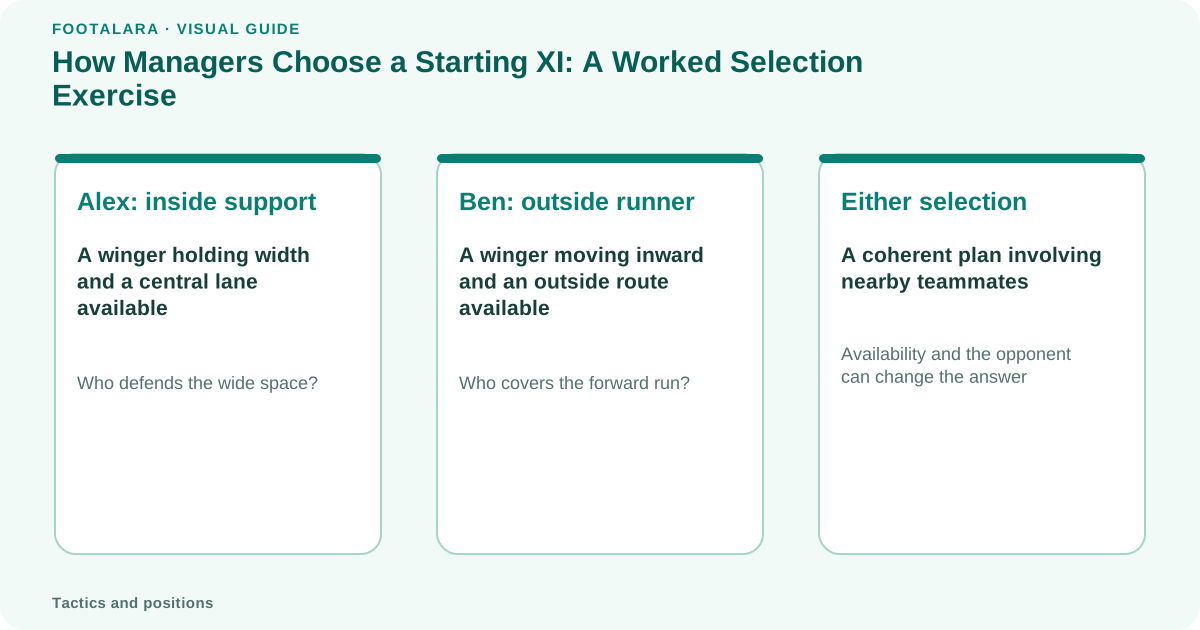
| Alex: inside support | A winger holding width and a central lane available | Who defends the wide space? |
| Ben: outside runner | A winger moving inward and an outside route available | Who covers the forward run? |
| Either selection | A coherent plan involving nearby teammates | Availability and the opponent can change the answer |
Make and defend one selection
- Choose the first or second fictional opponent scenario.
- Select Alex or Ben and state the space the choice uses.
- Assign one teammate to support and one to cover.
- Write the match event that would make you reconsider.
Practical checklist
- Define the match problem
- Pair complementary tasks
- Test the turnover
- Give the bench a conditional role
Test your understanding
Try each question before opening the answer. Use the explanation to check your reasoning.
Which Tottenham Kane–Lucas selection fact does the official 2019 final lineup confirm?
Show answer and explanation
Kane started and Lucas appeared among the substitutes.
The official lineup establishes their status; it does not disclose every reason for the decision or prove the unchosen alternative's outcome.
What changed in Bayern's starting XI between the 2020 semi-final and final?
Show answer and explanation
Kingsley Coman replaced Ivan Perišić; Bayern kept the other ten starters.
Comparing the two official tactical sheets isolates one personnel change before adding any tactical interpretation.
Frequently asked questions
Should the eleven highest-rated players always start?
An individual rating does not describe how the players' tasks fit together. Use the exercise to check width, passing options and cover before judging a lineup as a unit.
Conclusion
A convincing selection links a player's strengths to the opponent and nearby teammates. Explain the first pass, the cover after a mistake and the condition for a change, and your XI becomes a plan you can assess.
Sources
- FIFA Training Centre — Rehanne Skinner: Using the goalkeeper for successful build-up
- FIFA Training Centre — Team organisation out of possession
- UEFA — Milan v Liverpool, official 2005 final line-up sheet
- UEFA — Liverpool triumph in Turkey, 25 May 2005
- UEFA — Ajax 2–3 Tottenham, Lucas Moura semi-final report
- UEFA — Tottenham v Liverpool, official 2019 final tactical line-up sheet
- UEFA — Lyon v Bayern, official 2020 semi-final tactical line-up sheet
- UEFA — Paris v Bayern, official 2020 final tactical line-up sheet
- UEFA — Paris 0–1 Bayern, official 2020 final report